Smoke study · Airflow visualisation
See the air.
Controlled, traceable smoke that turns airflow into a record you can put in front of an auditor.
What it is
What a smoke study really shows.
We generate controlled, traceable smoke to visualise how air actually moves through your environment. The result is a real-time record of airflow patterns, dead zones, pressure cascades, ventilation gaps, and the effect of operator interventions — evidence that QA, validation, engineering and audit teams can act on.
Studies are conducted at rest, during setup, in operation, and across routine interventions. The footage is captured and organised against the standard that applies to your facility, so it slots straight into the documentation your own team maintains.
10+
smoke study projects delivered for CSL Behring.
One of the world's leading biotechnology companies, with major manufacturing operations in Melbourne.
What we examine
Six conditions, captured on every study.
Grade A
Unidirectional airflow
Whether first air reaches the critical zone intact, with no ingress from lower-grade areas.
Δt
Recovery time
How quickly unidirectional flow re-establishes after an intervention or a door opening.
≥10 Pa
Pressure cascades
Differential pressure between adjacent grades, and whether the cascade holds under real movement.
Re
Turbulence & dead zones
Eddies and stagnation regions where particles are trapped, redirected or held in suspension.
MAL / PAL
Transfer pathways
Airflow behaviour during material and personnel transfers between classified rooms.
2 states
At rest vs in operation
Static and dynamic conditions, including operator activity performed to your SOP.
Method
From protocol to delivery — four deliberate steps.
A study is only as good as the protocol behind it. Ours is agreed before anyone brings a fog generator into a classified area.
01
Plan
We walk the site, define objectives, identify zones, and agree acceptance criteria and intervention scenarios in writing.
02
Generate
Controlled, traceable smoke is deployed with calibrated equipment and documented safety controls, positioned so the applicator itself does not disturb the flow being measured.
03
Capture
Multi-angle high-resolution video and stills record airflow behaviour at rest and in operation, with zone and condition logged against every clip.
04
Deliver
You receive the complete raw capture, plus footage edited to your scope, labelled by zone and condition and delivered in a searchable dashboard your team can take straight into a review or an inspection.
Equipment
Professional-grade fog generation.
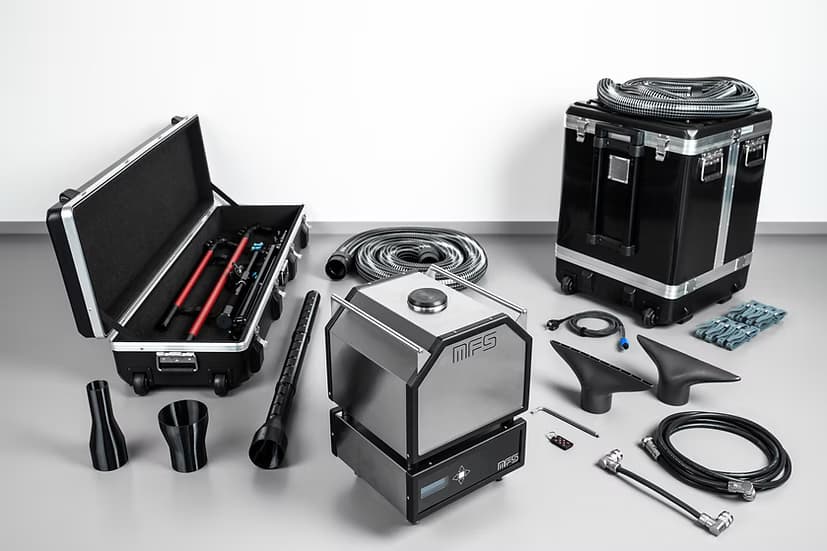
We deploy the Mr Fogger RAPS — a Remote Applicator Probe System built specifically for pharmaceutical, cleanroom and critical-environment smoke studies. Every component is chosen for GMP compatibility.
Mr Fogger RAPS
Remote Applicator Probe System
We deploy the Mr Fogger RAPS — a Remote Applicator Probe System built specifically for pharmaceutical, cleanroom and critical-environment smoke studies. Every component is chosen for GMP compatibility.
- Controlled output
- Digitally regulated fog density for consistent, repeatable results across zones and across visits.
- Pure water-based
- Runs on WFI, DI or distilled water only. No glycol, no oil, no residue — nothing left behind in a classified area.
- Remote applicator probe
- A telescoping wand reaches diffusers, HEPA faces and confined spaces without the operator disturbing the airflow under test.
- Wireless operation
- Remote activation keeps personnel clear of the critical zone while capture is running.
- Portable flight cases
- The complete system packs into wheeled cases — deployable to any site in Australia.
- Calibrated & traceable
- Equipment maintained to documented standards, so the instrument itself is audit-ready.
See it in action
Our fogger, running.
The same RAPS system we bring to every engagement, generating controlled fog. Clean, consistent output designed for pharmaceutical and cleanroom environments.
Deliverables
What you receive.
Included in every study. We capture, hand over and organise the visual evidence — your QA and validation team draw the conclusions and write them up against your own criteria.
01
Raw footage
The complete unedited capture, handed over in full. Your primary evidence stays yours, independent of anything we edit.
02
Edited footage
Cut to the scope you specify — the zones, conditions and interventions your team actually needs to review.
03
Searchable dashboard
A custom browser-based dashboard for viewing the edited footage, organised by zone, study date and intervention type.
04
Multi-angle capture
High-resolution video of airflow behaviour from every angle agreed at protocol stage.
05
Both operating states
Coverage at rest and in operation, including the routine interventions your operators actually perform.
06
Zone-referenced clips
Every clip carries its zone, date and condition, so a piece of footage still means something two years after the study.
Included with every study
A searchable dashboard — not a folder of clips.
Alongside the raw capture, every study ships with a custom browser-based dashboard for viewing the edited footage — organised by zone, study date and intervention type. Search across clips, filter to a room, and jump to the moment you need. Built for engineers and auditors who need to find evidence in seconds rather than trawl a shared drive.
- Search across every clip
- Filter by zone or study date
- Browser-based — nothing to install
- Plays on a laptop, in the audit room, or on site
P Square has delivered more than ten airflow visualisation studies at our facility. Their on-site execution is professional and we've consistently appreciated the turnaround time on the edited footage. The custom HTML dashboard they ship with each study — searchable and organised by zone and date — saves us real time over folder-trawling, and the whole package has been genuinely helpful during audits.
Where it matters
Different rooms. Different failure modes.
The method is consistent. What we look for is not.
Pharmaceutical manufacturing
Grade A/B aseptic processing, where Annex 1 expects visualisation at rest and in operation, with footage retained.
Hospitals & healthcare
Operating theatres, isolation rooms and pharmacy compounding, where airflow is an infection-control barrier.
Cleanrooms
ISO-classified spaces of any grade, including recovery testing and classification support.
Biotech & laboratories
Containment verification, safety cabinet performance, and cross-contamination pathways between suites.
Data centres
Hot and cold aisle separation, bypass air, and recirculation that quietly costs you cooling capacity.
Industrial facilities
Local exhaust ventilation, fume capture at source, and operator breathing-zone exposure.
Warehouses & cold chain
Temperature stratification and dead zones that undermine mapping and product storage.
Tunnels & confined spaces
Ventilation effectiveness and smoke behaviour where egress and dilution are safety-critical.
Planned against
The standards your inspector will name.
We agree the reference and the zones before the study, so the footage covers exactly what your own documentation needs to point at.
- EU GMP Annex 1Manufacture of Sterile Medicinal Products
- The 2022 revision made airflow visualisation an explicit expectation for grade A zones, performed both at rest and in operation, with recordings retained. It is the reason most of our pharmaceutical work exists.
- PIC/S PE 009Guide to Good Manufacturing Practice
- Adopted by the TGA for Australian manufacturers. Annex 1 of the PIC/S guide carries the same requirement for demonstrating unidirectional airflow and protection of the critical zone.
- ISO 14644Cleanrooms and associated controlled environments
- Parts 1 and 3 define classification and the test methods that airflow visualisation supports, including airflow direction and the recovery behaviour of a room after disturbance.
- TGATherapeutic Goods Administration
- Australia's regulator for therapeutic goods. Inspectors routinely ask to see airflow evidence for aseptic areas — footage that is dated, zone-referenced, and traceable to a defined study protocol.
A study is also the best training material you will ever film.
The footage that proves your room works is the same footage that shows an operator why the SOP says what it says. We convert completed studies into structured training modules for the teams who work in the room.
Common questions
What clients ask before booking.
Do we have to shut down production?
Not necessarily. Studies are normally run in both at-rest and in-operation states, and the in-operation portion needs the room working the way it really works. Scheduling is agreed during protocol planning — most clients slot the study into a planned shutdown, a changeover, or a quiet shift.
Is the fog safe in a GMP area?
Our system runs on WFI, DI or distilled water only — no glycol and no oil. There is no residue and nothing is deposited on surfaces or product-contact equipment. Cleaning and release requirements remain yours to define, and we work to whatever your site procedure specifies.
How long does a study take on site?
It depends on the number of zones and the intervention scenarios agreed. A single critical zone can be captured in a few hours; a multi-room aseptic suite with transfers and interventions is usually a full day or more. We scope this in the protocol so there are no surprises on the day.
How quickly do we get the footage back?
Edited footage and the dashboard follow the on-site work. Turnaround is agreed up front and is one of the things clients most often tell us they value — see the CSL Behring comment on the smoke study page.
Do you write the report, or do we?
You do. We capture and deliver the visual evidence — edited, zone-referenced footage in a searchable dashboard — and your QA or validation team assesses it against your acceptance criteria and writes it into your own documentation. We agree the standard and the zones up front so the footage covers exactly what your report needs to reference.
Ready to see your airflow?
Tell us the room, the grade and the deadline. We will come back with a protocol and a date.